Description
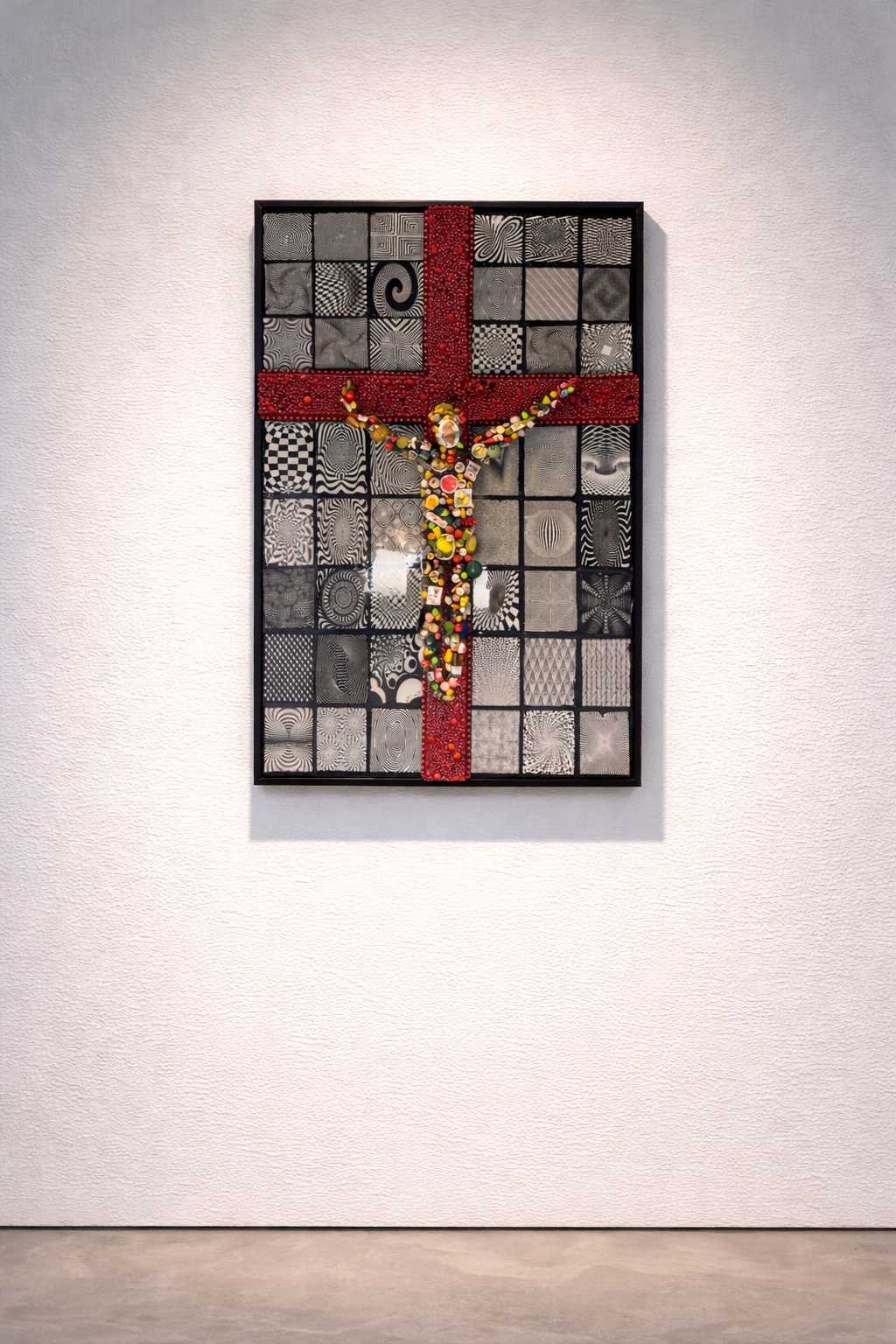
The Banquet emerges from the artist’s immersive exploration of spiritual communities across Fort Collins, where he attended churches, mosques, and diverse places of worship in search of understanding. This work reflects a pivotal moment within that journey—an encounter with a Baptist congregation that emphasized total adherence to scripture, asserting that truth lies in accepting the entirety of the Bible rather than selecting fragments that comfort or affirm personal belief.
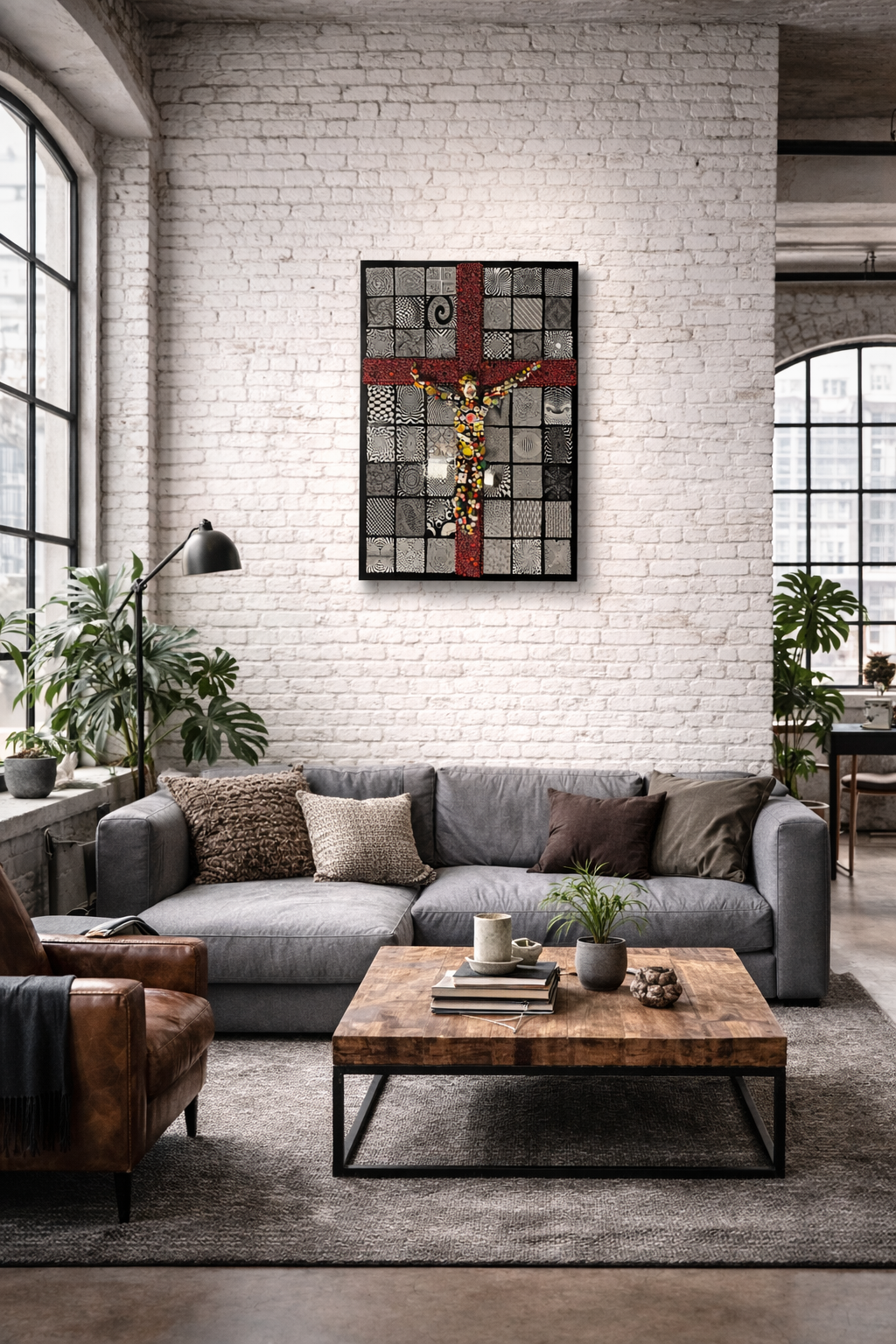
At the center of the composition stands a cross, constructed densely from red beads and embedded objects, evoking both the physicality and symbolism of the blood of Christ. From this vertical axis, a human figure emerges—formed from an assemblage of miniature food items, trinkets, and everyday objects—suggesting the idea of a “spiritual body” composed of what one consumes, both literally and metaphorically. The figure becomes a living metaphor: belief as nourishment, doctrine as diet, faith as something ingested and digested.
Surrounding the central form is a grid of black-and-white optical patterns—hypnotic, disorienting, and endlessly shifting. These illusions represent the multiplicity of religious interpretations and the human tendency to perceive certainty where ambiguity persists. Each pattern asserts itself as truth, yet collectively they reveal contradiction, distortion, and the instability of perception itself.
The work’s title, The Banquet, reflects a central tension: is faith meant to be consumed selectively, like choosing favorite dishes, or accepted in its entirety, regardless of difficulty or discomfort? The artist resists a definitive answer. Instead, he questions the notion that any one institution—or individual—can claim complete understanding. The piece ultimately becomes less about doctrine and more about humility, suggesting that while love may be the closest shared understanding of the divine, certainty itself may be the greatest illusion.
In this way, The Banquet stands not as a declaration of truth, but as an invitation to reflect—on belief, perception, and the ever-shifting nature of what we think we know.